Short answer: warm minimalism replacing stark-white spaces, traditional Pakistani elements like jaali screening reworked for contemporary homes, and climate-responsive design like courtyards and passive cooling. Trend lists are usually written from a distance — someone summarizing what a handful of international design blogs said, repackaged for a local audience. This isn’t that.
Warmth is replacing stark minimalism
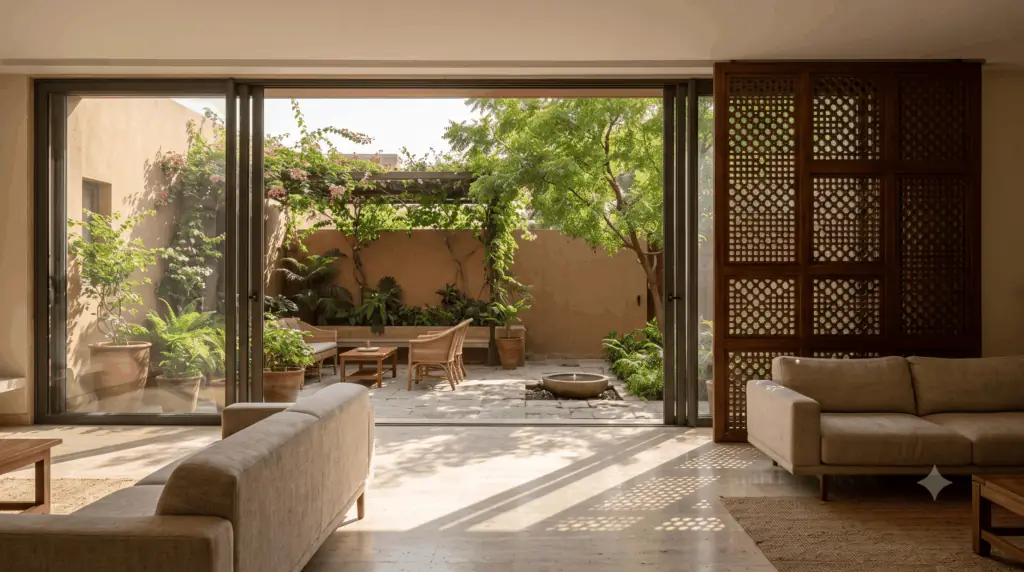
For a while, “minimalist” meant white walls, white furniture, and not much else — clean, but often cold in practice, especially in a home people actually live in day to day. What we’re seeing more of now is warm minimalism: still restrained and uncluttered, but built from natural materials, warmer neutral tones, and visible texture — wood grain, textured plaster, woven elements — instead of flat white surfaces doing all the work. It reads as calm without reading as empty.
Natural materials and greenery, used properly
Biophilic design — bringing natural materials and plant life meaningfully into a space, not just as an afterthought — keeps coming up, and for good reason in Pakistan’s climate specifically. Courtyards, indoor greenery, and natural light aren’t just aesthetic choices here; they genuinely affect how a home feels to live in through the hotter months. We’re seeing more clients ask for this deliberately, rather than treating a few potted plants as decoration added at the end.
Materials people are asking about by name now
A few years ago, most clients left material selection almost entirely to us — general direction, not specifics. That’s shifted. More clients now come in already asking about specific materials: natural stone over engineered alternatives, locally sourced wood instead of imported options, and metal accents in warmer tones rather than the cooler chrome finishes that were common before. Part of this is aesthetic preference, but part of it is genuine interest in sourcing locally where quality allows — both for cost reasons and because clients increasingly care where materials actually come from, not just how they look in the finished room.
Traditional elements, reworked rather than replicated
This is the one we care about most, honestly, because it’s specific to where we work rather than something lifted from an international trend report. There’s a real shift happening away from purely imported, generic “modern” interiors toward spaces that reference traditional Pakistani and South Asian design — jaali-inspired screening, traditional proportions, regional materials — reworked with a contemporary hand rather than copied wholesale. It’s less about nostalgia and more about clients wanting a home that actually feels like it belongs where it is, instead of looking like it was dropped in from somewhere else. A jaali screen used for light and privacy control does real functional work in our climate — it’s not purely decorative the way it might read out of context.
Rooms that do more than one job
The push toward flexible, multi-functional spaces hasn’t faded the way some post-2020 trends have — if anything, it’s become a standard expectation rather than a special request. A guest room that converts to a home office, a family lounge that can host formal guests without a full renovation, a kitchen island that does double duty as a casual dining spot. Clients are less interested in a room with one fixed identity and more interested in a room that flexes with how the household actually uses its time.
Lighting as a design decision, not an afterthought
Lighting used to be one of the last things decided on a project — whatever fit the budget left over at the end. That’s changing. We’re seeing lighting treated as an actual design element: layered lighting instead of a single ceiling fixture, warmer color temperatures, fixtures chosen to do real work shaping how a room feels in the evening rather than just illuminating it. It’s a relatively small line item that changes how a finished space actually reads, which is probably why more clients are willing to prioritize it earlier in the process now instead of leaving it for last.
Designing with the climate, not against it
This overlaps with the greenery point above but goes further: more clients are asking upfront about passive cooling strategies, cross-ventilation, and shading — not as an environmental statement, but because it directly affects utility bills and comfort during Pakistan’s hotter months. Deep verandas, correctly oriented windows, and courtyard airflow aren’t new ideas — they’re traditional design logic that’s coming back into deliberate use rather than being treated as something modern design left behind. It’s a good example of a “trend” that’s really just a return to something that always worked, now being asked for by name instead of happening by accident.
What we’d caution against
Not every trend is worth chasing, and it’s worth saying that plainly rather than just listing things enthusiastically. Anything picked purely because it’s currently popular — a specific accent color, a viral furniture shape — tends to date a space faster than a more considered choice would. The interiors that hold up well over years are usually built around the same fundamentals regardless of what’s trending: how the space is actually used, how light moves through it, and materials chosen for how they age, not just how they photograph on day one.
Questions people ask us about this
Is warm minimalism just a rebrand of what was already popular? Not entirely — the restraint is similar, but the material palette and warmth are a genuine shift from the starker, colder version of minimalism that was common before. It’s less about a new look and more about the same discipline applied with different materials.
Do these trends apply to interior projects specifically, or the BIM Interior modeling course too? They’re related but distinct — trend awareness is design thinking, which is what our Interior Design Course actually teaches, versus the Revit software skills covered in BIM Interior. We’ve written more on that specific distinction if you’re deciding between the two.
Should I redesign my space around these trends, or is that a waste of money? Full redesigns rarely make sense purely to chase a trend. Most of what we’ve described here — warmth, natural materials, better lighting, more flexible room use — can be introduced incrementally into an existing space rather than requiring you to start over. A lighting upgrade or a material change in one room is often enough to shift how a whole space feels, without touching everything at once.
How long do interior trends like this usually last before they change again? Genuinely hard to say precisely, and we’d rather be honest about that than pretend to a false level of certainty. The materials-and-warmth shift feels more like a real correction from stark minimalism than a short-lived fad, but trend timelines are never guaranteed — which is exactly why we lean toward fundamentals holding up better than trend-chasing in the first place.
If you’re planning a project around this
Book a consultation if you want to talk through what actually makes sense for your specific space, rather than a generic trend checklist. Our project portfolio has more examples of how this plays out in real interiors.
Written by Asiya Ansari (Chief Architect)